- /
- ... /
- Visbion

Diagnostic Imaging Infrastructure Scaling & DevOps Modernization
Our collaboration with a UK-based medical imaging technology provider aimed at improving platform scalability through architecture redesign, infrastructure automation, and performance optimization.
client
Visbion
cooperation
Since 2023
country
UK
industry
Healthcare / Medical imaging
product
DICOM routing, compression, encryption & device management platform (Image Cube)

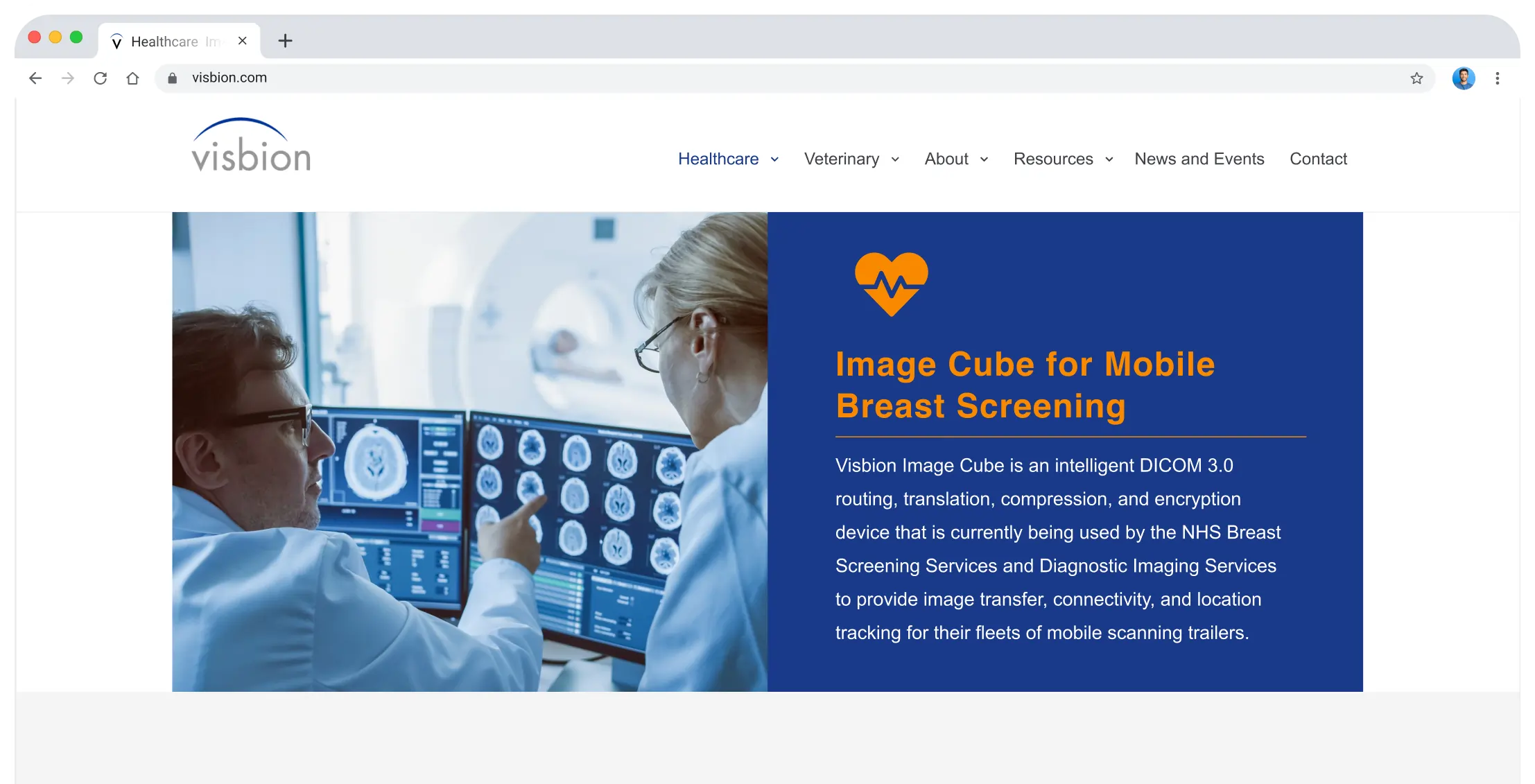
About the platform
Visbion provides Image Cube, a DICOM 3.0, compliant routing, translation, compression, and encryption device. The platform supports secure image transfer, connectivity, and fleet tracking for mobile scanning units used by the NHS Breast Screening Services and Diagnostic Imaging Services.
The solution was founded as a spin-out from Imperial College London by a contributor to the DICOM standard and operates in a highly regulated, zero-downtime healthcare environment.
Team
3
DevOps & infrastructure engineers
Objectives
The client engaged us to:
- Prepare the platform for substantial and safe scaling without service disruption.
- Enable safe scaling of the platform.
- Reduce operational risk in fleet management.
- Improve performance and reliability of imaging solution.
- Automate infrastructure and device lifecycle management.
The goal was clear: scale a complex, mission-critical healthcare infrastructure without compromising performance, security, or continuity of services.
Challenges
- Manual and partially automated device management.
- Limited scalability of the existing infrastructure.
- Performance constraints under increasing data volumes.
- High operational risk in a regulated healthcare environment.
- Growing fleet size without solid infrastructure.
- Need for zero downtime across critical imaging services.
Infrastructure & DevOps strategy
Work on infrastructure was guided by four principles:
- Predictable, repeatable deployments.
- Controlled change management.
- Operational visibility at fleet scale.
- High performance.
- Resilience over feature velocity.
All changes were implemented with healthcare compliance and service continuity as non-negotiable constraints.
Our approach
Step 1
Infrastructure audit & bottleneck identification
We started with a comprehensive audit of the existing infrastructure:
- Reviewed deployment, monitoring, and update processes.
- Assessed operational risks tied to manual workflows.
- Identified scalability and performance bottlenecks.
- Mapped infrastructure constraints against projected growth.
Step 2
Infrastructure automation
Processes needed to be streamlined, which required automation.
- Automated provisioning and configuration processes.
- Standardized deployment across environments.
- Reduced dependency on human intervention.
- Minimized human errors.
Step 3
Performance optimization
We optimized the software stack running on Image Cube devices:
- Improved DICOM data processing efficiency.
- Optimized compression and encryption workflows.
- Reduced latency in image transfer pipelines.
- Increased overall throughput under load.
Step 4
Architecture redesign for scalability
To support future growth, Flyant proposed and implemented a scalable architecture model:
- Cloud-integrated infrastructure components.
- Modular design for incremental expansion.
- Improved observability and monitoring.
- Architecture prepared to handle larger device fleets.
Infrastructure & DevOps outcomes
- Scalable infrastructure ready for significant fleet growth.
- Reduced operational and maintenance effort.
- Improved performance and data transfer reliability.
- Lower risk of service disruption.
- Strong foundation for future feature and device expansion.
Business outcomes
Scalable growth without risks
The platform is now ready to support hundreds of Image Cube devices across the UK without architectural strain. New devices can be onboarded quickly through standardized, automated provisioning, and deployments can scale without disruptive rebuilds or downtime.
Reliable, zero-downtime diagnostic workflows
Optimized DICOM routing, compression, and encryption pipelines improved stability and throughput under load. Reduced latency and fewer transfer failures strengthened reliability across diagnostic imaging services, directly supporting continuity of care in a zero-tolerance NHS environment.
Lower operational cost per device
Automation replaced manual device lifecycle management, significantly reducing engineering effort spent on configuration, updates, and maintenance. As the fleet grows, the marginal cost and operational effort per device decrease, improving economics.
Reduced operational and compliance risk
Repeatable, automated deployment processes lowered the risk of human error, while better observability enabled earlier detection of performance issues. This increased predictability and reduced regulatory exposure in a highly controlled healthcare setting.
Long-term platform readiness
The new modular, cloud-integrated architecture provides a stable foundation for future feature expansion and fleet growth. Visbion can now evolve its platform without compromising performance, reliability, or compliance, shifting focus from firefighting to planned, sustainable growth.
Client
success
The engagement positioned Visbion to scale its diagnostic imaging solution while maintaining the high reliability standards required by national healthcare services.
Flyant’s work ensured Visbion could grow its device fleet, improve operational efficiency, and continue supporting NHS diagnostic services without compromising performance or compliance.
This case demonstrates Flyant’s ability to modernize and scale mission-critical healthcare infrastructure, where failure is not an option and reliability directly impacts patient care.
Facing similar challenges to Visbion?
