- /
- ... /
- Thrive Mental Wellbeing

Quality Assurance for a Mental Health Telemedicine App
A dedicated QA engagement helping a digital mental health provider stabilize releases, reduce client-reported issues, and maintain NHS-compliant quality standards across web, mobile, and admin applications.
client
Thrive Mental Wellbeing
cooperation
Since 2023
industry
Healthcare / Mental Health / Telemedicine
product
Admin panel, web and mobile applications for digital mental health services

About the platform
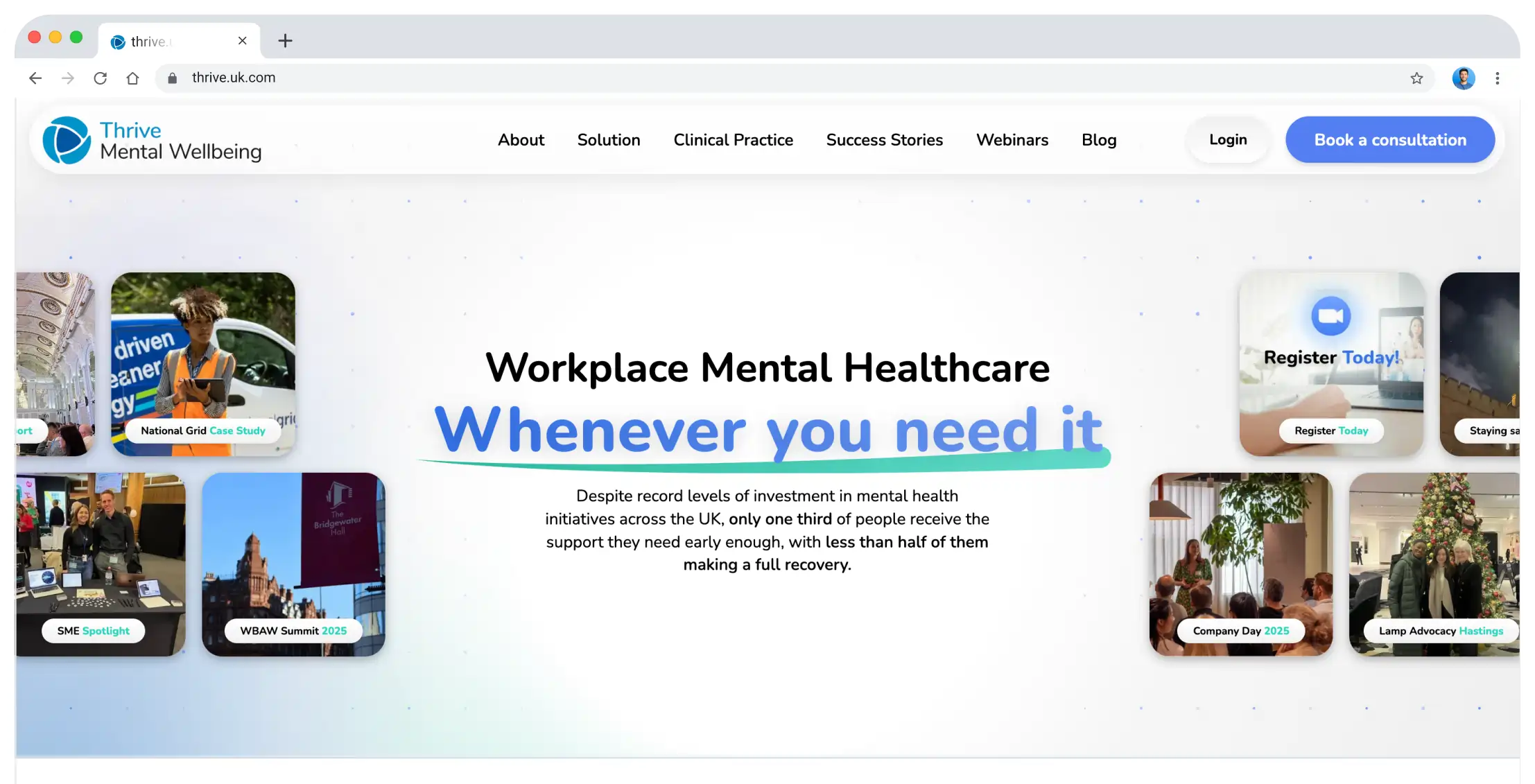
Thrive Mental Wellbeing provides confidential, NHS-compliant digital mental health services. The platform enables access to clinically proven therapy through web and mobile apps and offers communication with therapists, appointment booking, mental health exercises, progress tracking, and ongoing support.
Team
2
Manual QA engineers
Tech stack

Shortcut

App Center

Figma

Swagger UI

Firebase Crashlytics

TestFlight

Google Spreadsheet

Android Studio

iMazing

Nuclino

Postman

Google Play Console

BrowserStack
Objectives
The client engaged us to:
- Ensure decent product quality across frequent releases.
- Reduce bugs reported by clients and therapists.
- Introduce structured QA coverage for all environments.
- Improve regression confidence without automation.
- Strengthen collaboration between QA and development teams.
The goal was to ensure predictable, high-quality releases in a regulated mental healthcare environment.
Challenges
- Inconsistent test coverage across environments.
- Fragmented and outdated regression documentation.
- Bugs reported by clients after releases.
- No unified smoke/sanity strategy.
- Growing feature scope across apps.
- High risk of regressions affecting patient-facing functionality.
Our approach
Step 1
Regression documentation rebuild
We began with a full audit of existing QA documentation:
- Executed existing regression checklists.
- Identified gaps, redundancies, and unclear cases.
- Clarified expected behavior with the development team.
Based on this, we rebuilt regression coverage:
- 6,000+ regression test cases for client applications.
- 1,500+ regression test cases for the admin panel.
Step 2
Smoke & sanity coverage for releases
To prevent critical issues from reaching production:
- Created targeted smoke and sanity checklists for each environment.
- Defined checks for every release stage.
- Introduced production validation for critical flows.
Step 3
Continuous feature testing
Apart from working on documentation, QA engineers:
- Tested all new features during active sprints.
- Processed:
- 1k+ tickets for the web app.
- 1.5k+ tickets for mobile apps.
- ~1k tickets for the admin panel.
- Participated in daily standups, reviews, and planning sessions.
Step 4
Admin panel quality protection
Special focus was placed on the admin panel due to its operational criticality:
- 98% functional coverage achieved.
- Early detection of data integrity risks enabled.
- Validation that releases do not break existing client setups.
Step 5
UX and communication improvements
QA engineers actively contributed beyond testing:
- Identified usability issues affecting patient experience.
- Collaborated with designers on UI/UX improvements.
- Created a client-facing FAQ to reduce non-development support requests.
QA engineering outcomes
- QA coverage aligned across all environments.
- Structured smoke, sanity, and regression processes.
- 6,000+ regression tests for client apps.
- 1,500+ regression tests for the admin panel.
- Major and blocker bugs consistently caught before release.
- Noticeable reduction in bugs reported by clients and therapists.
Business outcomes
Release risk reduced to near zero
All major and blocker defects are now detected before production. This removed emergency hotfixes, reduced rollback risk, and protected patient-facing mental health workflows where failures directly impact care delivery.
Higher trust from therapists and clients
The drop in client- and therapist-reported bugs increased confidence in the platform. Fewer disruptions during therapy sessions and follow-ups improved perceived product reliability, critical for a mental health service operating in regulated environments.
Controlled growth without automation dependency
By building deep, structured manual QA coverage, the client achieved stability without rushing into automation. This kept QA costs predictable while the product continued to evolve rapidly across web, mobile, and admin systems.
Protection of clinical and operational data
Extensive admin-panel and data-integrity testing ensured that releases do not corrupt configurations, patient data, or reporting workflows, reducing legal, compliance, and reputational risk.
Faster decision-making for product and engineering
Clear regression, smoke, and sanity criteria gave teams immediate confidence in releases. Product decisions shift from “Can we risk releasing?” to “What delivers the most value next?”
Lower long-term cost of quality
Well-maintained QA documentation, reusable checklists, and clear ownership reduced dependency on tribal knowledge. The other advantages include lower onboarding costs, minimized rework, and c a QA foundation that scales with the product.
Stronger delivery discipline across teams
Embedded QA improved story definition, prioritization, and UI/UX clarity. Engineering teams spent less time fixing late-stage issues and more time on planned improvements.
Client
success
Thrive Mental Wellbeing strengthened its quality assurance foundation without slowing delivery. The platform now supports frequent releases while maintaining reliability, usability, and compliance, critical for mental healthcare applications where user trust and continuity of care matter.
This case demonstrates Flyant’s ability to deliver manual QA services for healthcare products where automation is not always the right first step, but quality cannot be compromised.
Facing similar challenges to Thrive?
