- /
- ... /
- CipherHealth

Test Automation for a Patient Engagement Platform
Helping a healthcare software provider speed up web and mobile releases while significantly reducing production risk through large-scale automation.
client
CipherHealth
cooperation
Since 2018
industry
Healthcare / Telemedicine
product
Patient engagement platform

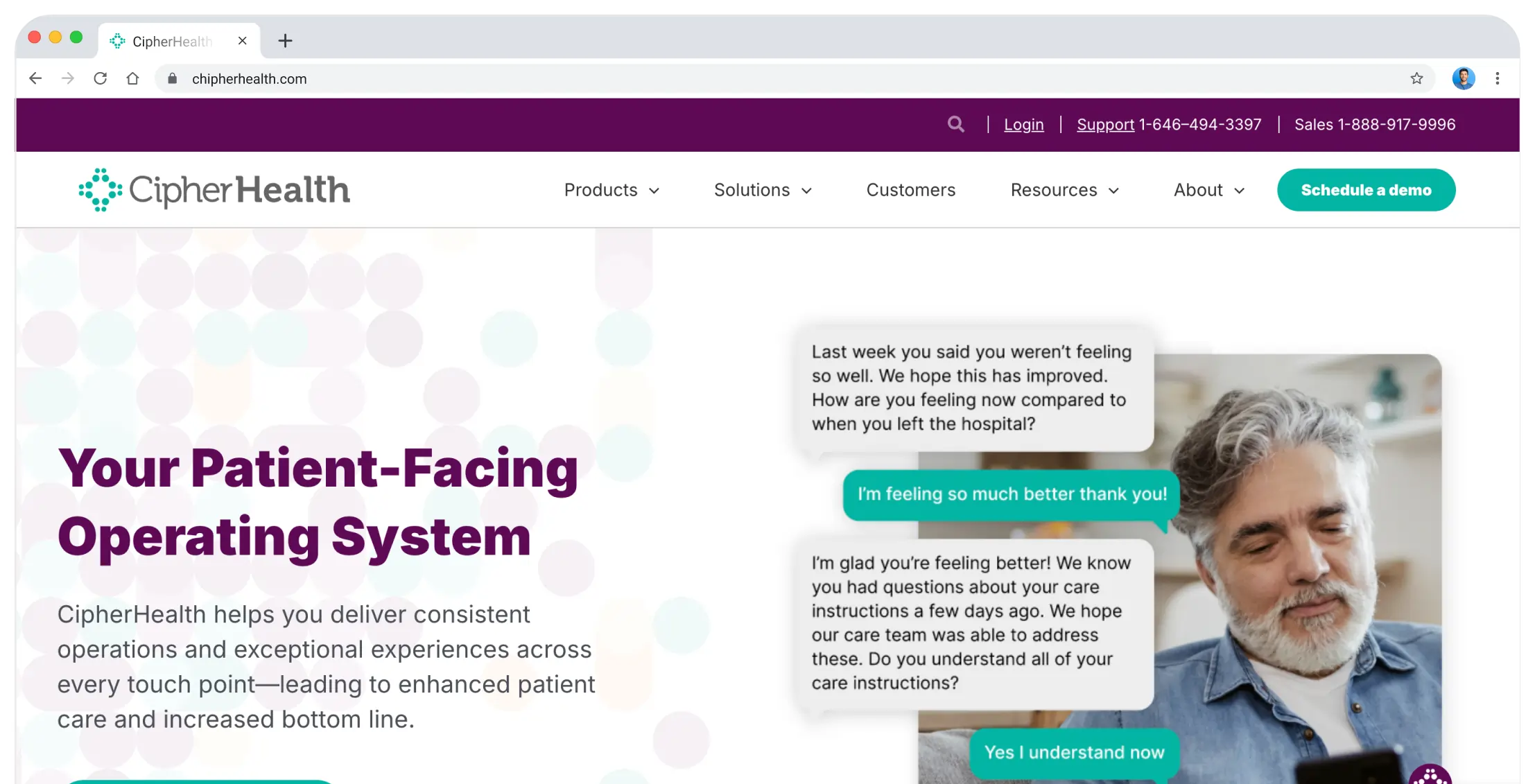
About the platform
CipherHealth provides a patient engagement solution used by healthcare providers for automated, personalized, and secure communication with patients. The platform supports digital check-ins, appointment reminders, post-discharge follow-ups, and health outreach while enabling providers to track patient engagement and outcomes.
Team
4
QA full-stack engineers
Tech stack

Ruby

Capybara

Selenium

Cucumber

Appium

Jenkins

Swagger

Faraday

Jira

Git

Apache JMeter

Twilio

MongoDB
Objectives
The client engaged us to:
- Reduce production defects.
- Speed up release cycles.
- Reduce manual regression efforts through scalable automation.
- Introduce API and mobile test automation.
- Enable parallel execution across environments.
The goal was to ensure frequent releases without compromising quality or compliance.
Challenges
- High number of undetected bugs reaching production.
- Manual smoke and regression testing.
- No API automation.
- Minimal unit tests.
- Single-thread test execution.
- Limited browser and mobile OS support.
- Testing was performed only in a single environment.
- ~20% of releases contained critical defects.
Our approach
Step 1
Automation framework built from scratch
- Designed a unified automation architecture for web, mobile, API, and DB testing.
- Implemented CI/CD process with up to 20 parallel threads.
- Enabled smoke and regression suites to run automatically on every build.
Result:
- Smoke tests take ~10 minutes.
- Full regression takes ~5 hours.
- 10× faster feedback loops.
Step 2
Web & API automation at scale
- 1,400+ end-to-end web automation scenarios.
- 250+ dedicated API tests.
- API calls embedded into ~80% of UI tests for data setup and validation.
- Support for the 3 latest browser versions.
Step 3
Mobile automation
- 100+ automated scenarios per platform.
- Coverage of critical user flows.
- CI/CD-triggered mobile builds and tests.
- Notifications delivered automatically to teams.
Supported:
- 2 latest iOS versions.
- 2 latest Android versions.
Step 4
Database & load testing
- Direct DB validation integrated into automated tests.
- ~90% coverage of DB-related changes.
- Load testing implemented to validate system stability.
- Manual verification retained for high-risk changes.
Step 5
Engineering collaboration
- QA engineers embedded across 5 product teams.
- Active participation in sprint ceremonies.
- Manual testing of ~95% of sprint stories.
- Continuous feedback to development and product teams.
QA engineering outcomes
- 1.4k+ automated web scenarios.
- 100+ automated mobile scenarios.
- 15 critical user flows covered end-to-end.
- 50+ automated jobs running in parallel.
- 10× faster regression execution.
- 2.5k+ bugs identified and reported.
- Tests executed across 4 environments, including production.
Business outcomes
Release velocity without quality trade-offs
Regression testing time was reduced by 10×, allowing the product team to ship updates continuously instead of batching releases around manual QA cycles. This way, QA isn’t perceived as a delivery bottleneck anymore, and predictable, on-time releases are enabled.
Fewer risks in production
The new QA foundation shifted defect detection earlier in the lifecycle:
- 35% fewer production bugs within the first 7 months.
- 60%+ of high-priority defects identified before release.
- Only a small fraction of issues reached end users.
This directly reduced operational risk for healthcare providers relying on the platform.
Stable scaling of product development
As feature volume increased, quality remained stable:
- 90% of delivered functionality covered by automated tests.
- Consistent quality across web, mobile, API, and database layers.
- No linear increase in QA effort despite growing product scope.
The team could scale development without scaling QA headcount.
Faster recovery and higher confidence releases
Automated smoke and regression suites running across 4 environments (including production) provided fast, reliable feedback after every change. This enabled teams to detect issues immediately and respond before they impacted users.
Reduced cost of quality
Manual regression was largely eliminated, freeing engineers from repetitive testing work. QA effort shifted from execution to prevention, improving ROI on both engineering and testing investment.
Stronger collaboration and delivery discipline
Engaged QA engineers improved cross-team coordination, which resulted in:
- Clearer acceptance criteria.
- Fewer late-stage surprises.
- Higher trust in release readiness.
This created a delivery process focused on confidence, not firefighting.
Client
success
CipherHealth achieved faster delivery cycles with significantly fewer production defects. The QA foundation built by Flyant enabled the platform to scale feature development while maintaining reliability, security, and user trust.
This case demonstrates Flyant’s ability to implement enterprise-grade QA processes for complex, multi-platform healthcare products operating under continuous delivery pressure.
Facing similar challenges to CipherHealth?
