- /
- ... /
- Arklign

Quality Engineering for a Dental Case Management Platform
A long-term QA engagement focused on establishing a complete quality foundation and evolving it into a scalable, release-ready testing system for a global dental case management platform.
client
Arklign
cooperation
Since 2016
country
USA
industry
Healthcare / Dental technology
product
Case relationship management platform

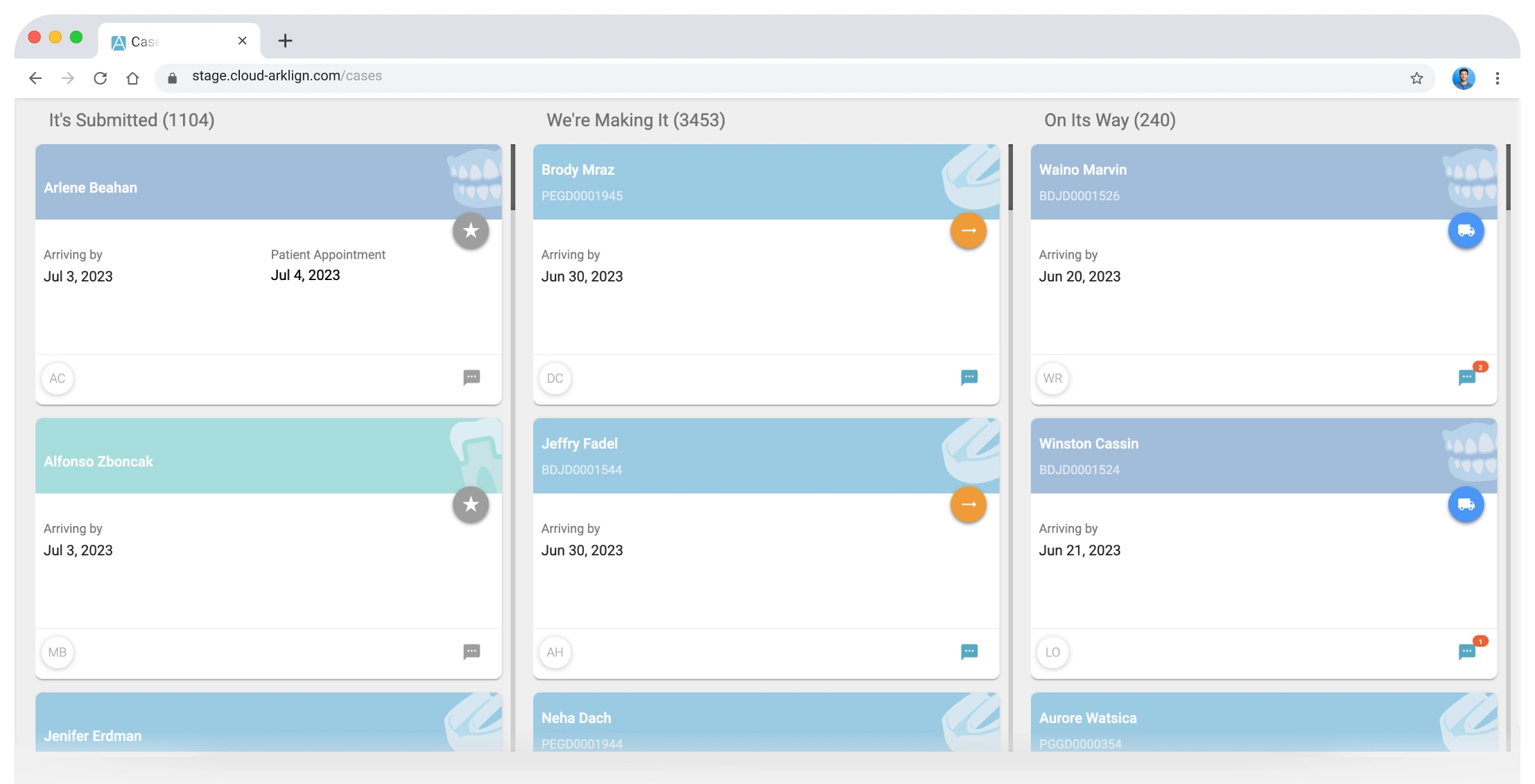
About the platform
Arklign is a healthcare technology solution that helps dental clinics and laboratories manage restoration cases end-to-end, from case submission and communication to tracking, logistics, and analytics, through a centralized web and mobile system designed for secure, compliant, and high-volume clinical workflows.
Team
2
Manual QA engineers
1
Automation QA engineer
Tech stack

Jira

Confluence

BrowserStack

GitHub

Postman

MS Office package

Azure

Apache JMeter

TestFlight

AppCenter

MailDev

WebDriverIO

Axios

Bitbucket CI
Objectives
Arklign engaged us to:
- Establish a full QA process from scratch.
- Introduce structured release workflows.
- Automate regression and smoke testing.
- Improve platform stability across web and mobile.
- Increase delivery speed without sacrificing quality.
The key goal was to move from zero QA structure to a scalable, automation-driven testing ecosystem.
Challenges
- No QA process.
- No test documentation.
- No structured release management.
- No automated E2E or API tests.
- High risk of production defects.
Our approach
Step 1
Building the QA foundation from zero
Reliable QA begins with structured documentation, especially in regulated domains. That’s why our first step was creating a solid documentation framework.
- Designed a comprehensive test plan aligned with real clinical and lab workflows.
- Prioritized high-risk user journeys and data-critical flows.
- Built structured regression coverage from scratch:
- 5,000+ test cases for the web platform.
- 2,000+ test cases for mobile applications.
- Achieved ~95% web and ~90% mobile functional coverage.
Step 2
Automation and CI/CD integration
With a stable foundation in place, we scaled quality through automation and continuous validation.
- Implemented:
- 900+ automated E2E tests covering critical user flows.
- 100+ automated API tests validating backend behavior.
- Enabled 24 parallel execution threads to keep feedback fast.
- Automated a smoke suite with just a ~10-minute execution time.
- Integrated QA execution directly into CI/CD pipelines.
Step 3
Performance and stability validation
Ensuring high performance was as important as guaranteeing functional accuracy.
- Conducted load and performance testing under realistic usage patterns.
- Monitored backend resource consumption during peak load.
- Identified performance bottlenecks early.
- Delivered actionable recommendations to prevent degradation as usage scaled.
Step 4
Continuous release support and quality control
QA has become a part of delivery, not a release-phase activity.
- Set up a clear, repeatable release validation process.
- Combined automated coverage with targeted manual testing for edge cases.
- Ensured every release met defined quality gates before reaching users.
QA engineering outcomes
- A fully structured and sustainable QA system established from scratch.
- Supported 100+ web and 50+ mobile releases.
- Early detection of high-severity defects embedded into the delivery cycle.
- Automation and manual testing working as a single, coherent quality layer.
- Stable release cadence maintained over multiple years.
- Quality ownership shifted from reactive bug fixing to proactive prevention.
Business outcomes
From zero process to controlled delivery
Arklign transitioned from no QA structure to a disciplined release process with predictable validation cycles.
Major defect prevention
Early detection of 3,000+ critical bugs prevented production disruptions, protecting clinical and lab workflows.
Faster, scalable releases
Parallel automation and CI/CD integration reduced manual overhead and enabled frequent releases without increasing QA headcount.
Platform stability at scale
Performance validation ensured the system remained stable under load as user adoption increased.
Stronger market positioning
Reliable delivery and platform stability supported Arklign’s growth and contributed to industry recognition, including inclusion in the Inc. 5000 (2018).
Client
success
Arklign evolved from an unstructured testing environment to a mature, automation-driven quality system. The platform now delivers stable web and mobile experiences for dental clinics and laboratories worldwide, supporting secure case management and real-time collaboration. This case demonstrates Flyant’s ability to build and scale enterprise-grade QA systems for healthcare platforms operating under continuous growth and compliance constraints.
Facing similar challenges to Arklign?
