- /
- ... /
- Abbott

Quality Engineering at Scale for a Global Glucose Monitoring Platform
Our collaboration with Abbott Laboratories to build and maintain a highly stable QA ecosystem for a cloud-based glucose monitoring platform used by millions of doctors and patients.
client
Abbott Laboratories
cooperation
Since 2019
country
USA
industry
Healthcare / Digital health / Diabetes care
product
Cloud-based glucose monitoring ecosystem (FreeStyle Libre)

About the platform
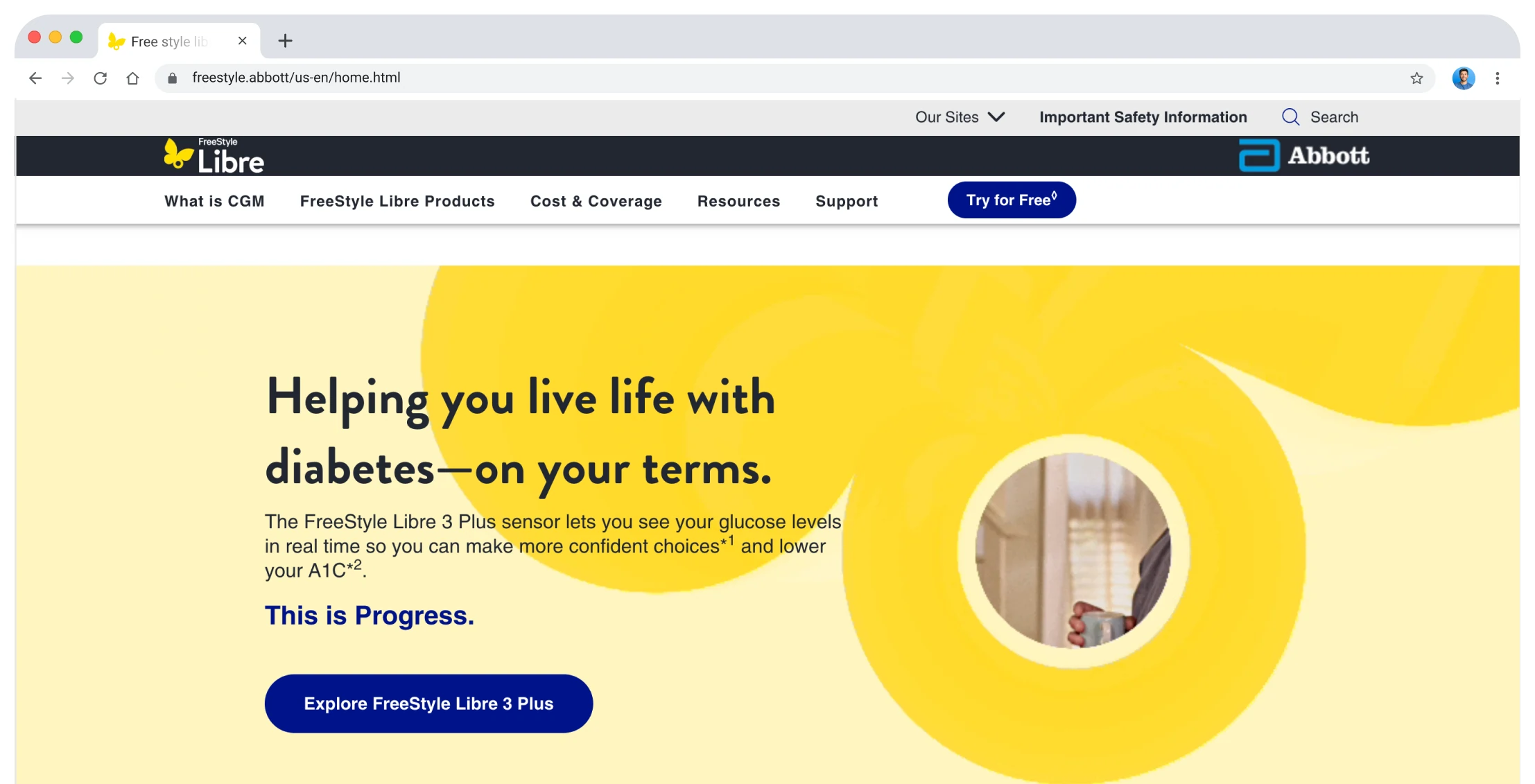
Abbott's FreeStyle Libre system is a cloud-based diabetes management system that collects real-time glucose data from wearable sensors and transforms it into clear, actionable reports. It supports patients, caregivers, and healthcare professionals in monitoring glucose trends, making informed clinical decisions, and managing diabetes more effectively across multiple global countries.
Team
20
Engineers
Tech stack

Jira

Confluence

qTest

Crowdin

Python

Robot Framework

GitHub

Postman

AWS WorkSpace
Objectives
The client engaged us to:
- Design and implement a scalable test automation solution.
- Continuously maintain automated test suites.
- Update test cases and maintain them on an ongoing basis.
- Increase overall and localization test coverage.
- Improve release predictability.
The goal was not simply to “add automation,” but to make the whole QA process structured and engineering-driven.
Challenges
- No mature automation framework.
- Regression testing taking up to 2.5 weeks.
- Smoke testing taking 7 days.
- Only ~50% test coverage.
- Limited device coverage.
- Insufficient testing of supported localizations.
- A lot of outdated and inconsistent test cases.
Our approach
Step 1
Test automation solution design
We designed and implemented a keyword-driven test automation solution using Python and Robot Framework.
The solution was built to be:
- Scalable across multiple country versions.
- Maintainable by distributed teams.
- Flexible enough to support rapid feature expansion.
- Integrated into CI pipelines.
Tests were designed around business-critical workflows rather than isolated UI elements, reducing long-term maintenance overhead.
Step 2
Regression & smoke optimization
Regression and smoke testing were restructured and automated step by step.
Results:
- Fully automated regression suite.
- Parallel execution across 4 web browsers.
- 10 parallel threads enabling faster runs.
- Automated country-specific smoke tests.
Regression testing time reduced from 2.5 weeks to 1 day.
Smoke testing was reduced from 7 days to 1 day.
Country-level smoke testing time reduced by more than 85%.
Step 3
Localization testing at scale
The platform supports 27 localizations across global markets.
We introduced:
- Automated coverage for translation validation.
- Locale-specific logic testing.
- Integration with localization management tools.
Over 70% of translations are now covered with automated checks.
Localization-related production issues were significantly reduced.
Step 4
API testing integration
To accelerate feedback cycles, API testing was integrated into both smoke and regression suites.
Approximately 50% of scenarios leverage API-level validation, allowing:
- Faster detection of backend issues.
- Reduced reliance on UI execution.
- More stable test outcomes.
QA engineering outcomes
- A regression suite consisting of 1,700+ tests.
- 1,500+ automated scripts created.
- 90% overall application test coverage.
- 27 supported localizations.
- 20+ devices supported (various OS versions, screen resolutions, browsers).
- Test running on 4 web browsers.
- Testing integrated into a CI/CD pipeline.
Business outcomes
Faster releases without added risk
Automation reduced regression and smoke testing cycles from weeks to days, allowing the product team to ship updates more frequently while maintaining stability. Release schedules became predictable, even as the platform scaled globally.
Lower operational QA costs over time
By automating high-volume and repetitive checks, the need for constant manual regression effort was eliminated. Manual QA resources were redirected to new features, exploratory testing, and edge cases instead of maintenance work.
Scalable global expansion
The QA setup supported rapid rollout into new countries without a proportional increase in testing time or risk. Localization issues were caught before production, enabling confident entry into new regulated markets.
Reduced production incidents
Early detection of critical, blocker, and localization-related defects significantly decreased the number of high-impact issues reaching production, a key requirement for healthcare software.
Higher confidence for stakeholders
Product, engineering, and business teams gained confidence in product quality. QA became a reliable signal for release readiness rather than a bottleneck or last-minute gate.
Long-term partnership value
Consistent outcomes led to team expansion and long-term collaboration. QA evolved from a tactical function into a strategic part of the product delivery process.
Client
success
The automated QA foundation enabled the client to scale its glucose monitoring platform globally while maintaining high stability and release confidence. Today, the platform is actively used by 4+ million users, with no critical defects or localization issues impacting production.
The engagement began in 2019 with a small QA team and grew steadily as the product expanded into new markets, including Taiwan, Slovakia, and Egypt. Based on consistent delivery quality, the QA scope and team were expanded over time.
Today, more than 20 QA engineers support the platform on an ongoing basis, working as part of the product team rather than as a separate testing unit.
Facing similar challenges to Abbott?
