

15 min read
June 30, 2026
Choosing a healthcare software development company is a compliance decision before it is a procurement one. You are not buying code. You are buying evidence — the kind an auditor, a notified body, or the FDA can inspect years later and accept without argument. When the wrong partner ships software that fails that inspection, the finding lands on your license and your roadmap, not on their invoice.
To choose a healthcare software development outsourcing company, weigh four things beyond engineering skill: documented compliance evidence, integration experience with real EHR and HL7 FHIR systems, an engineering-and-QA model that produces a maintained traceability matrix, and a portfolio of products that passed regulatory audit. Certifications alone prove nothing.
This guide covers the evaluation criteria that separate vendors, the audit evidence your partner must hand you, the red flags worth ending an evaluation over, and how the decision changes when your product is a medical device.
Why choosing a healthcare software development company is a compliance decision, not a procurement one
Most guides treat this as procurement with a HIPAA line item. That framing misses what makes healthcare different.
Three constraints generalists underestimate. Regulatory burden, which an external party will later inspect and which you cannot delegate away. Interoperability with systems you do not control and cannot fully test against. And clinical workflow, where a design shortcut becomes a patient-safety event rather than a support ticket.
A generalist SaaS shop can build a working application. The question is whether the application — and the trail of decisions behind it — survives an audit. Those are different deliverables, and only one of them is yours to defend.
One myth to retire first. There is no official HIPAA certification for software vendors. No government body certifies HIPAA compliance, and no legitimate auditor issues a "HIPAA certified" stamp for a development firm. A vendor who claims one is telling you they do not understand the regulation they are selling against. Treat it as a disqualifier, not a credential.
The evaluation criteria that actually separate vendors
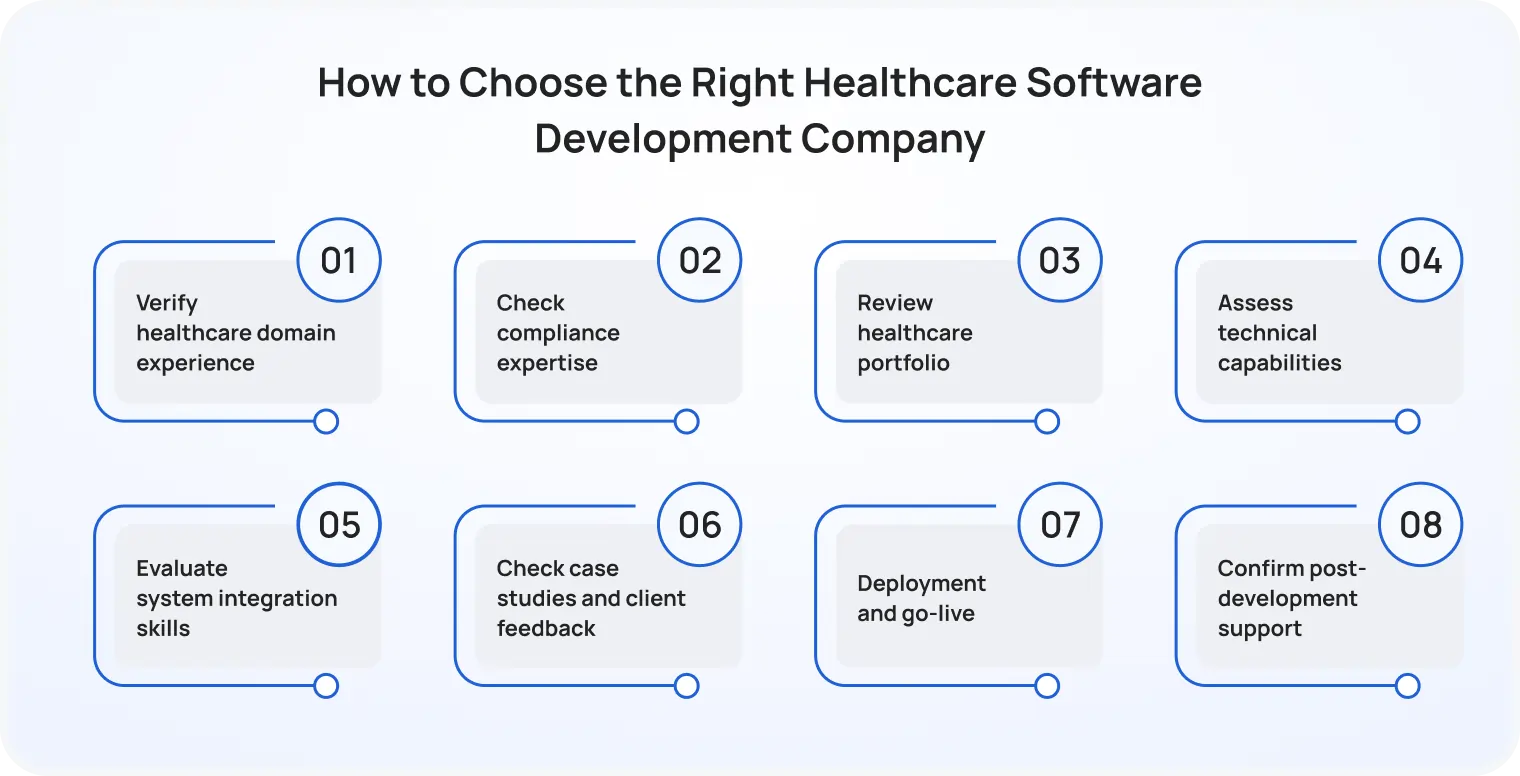
Every guide publishes a list of healthcare software development company evaluation criteria. The lists are mostly the same, and mostly correct as far as they go. Cover the table stakes quickly, then spend your evaluation time where vendors actually diverge.
The eight criteria, compressed
Domain expertise — direct, recent work in your regulatory class, not "healthcare-adjacent."
Compliance evidence — documented policies and artifacts, not declarations.
Integration track record — real EHR and HL7 FHIR work, named systems, production data.
Security posture — SOC 2 Type II with the report available to read, not a logo on a slide.
Engineering and QA model — one function that owns V&V, not testing bolted on at the end.
Methodology — risk-based testing and design controls suited to regulated builds.
Support and SLA — a defined post-launch response, including for compliance-affecting defects.
References — calls with the technical lead on a comparable build, not a curated sponsor quote.
How to Choose the Right Healthcare Software Development Company
Engineering and QA as one function
When engineering and QA are separate vendors — or separate teams behind a contract boundary — the traceability matrix is the first thing to break. Requirements live in one team's tracker. Tests live in another's. The link between a requirement, the design that satisfies it, and the test that proves it gets maintained by hand, across a seam, under deadline.
That seam is where audit findings come from. A requirement changes late, the test that verified it never re-runs, and nobody updates the trace because the trace is somebody else's job.
A single function owns verification and validation end to end. The group that builds the feature writes the verification protocol, runs it, and keeps the trace current as requirements move. You are not buying two services and hoping they reconcile under pressure. That's the dedicated-team model. Staff augmentation puts engineering and QA under one contract, one owner — a single function accountable for the trace, not two vendors defending a boundary.

One function. One trace. No seam.
Engineering and QA under one contract, one owner — the traceability matrix stays current as requirements move.
How to test domain expertise in the room
Domain expertise is the criterion every vendor claims and few can demonstrate. You can settle it with one question.
Ask: "Walk me through how a requirement change in this feature would propagate through your traceability matrix and trigger re-validation."
A team that has shipped regulated software answers in specifics — which artifacts update, which tests re-run, what evidence the change generates, how the risk file gets revisited. A generalist describes a Jira ticket. The gap is immediate, and it is not bluffable in a live conversation.
Pair it with a second question, the one most evaluations skip: "Walk me through two or three portfolio projects closest to mine in regulatory complexity." Not their biggest logo. The closest match to your regulatory surface. A partner who has been there describes the findings they engineered around. A vendor who has not will reach for a project that was never inspected.
What the auditor will ask for: the evidence trail your vendor must hand you
Every other guide tells you what to ask the vendor. None tells you what someone else will ask you, later, with the authority to stop your release.
An audit — HIPAA, SOC 2, FDA, or a notified body under ISO 13485 — does not inspect intentions. It inspects artifacts. The vendor's real job is to produce those artifacts as a byproduct of the work, from day one, so you are never reconstructing evidence under inspection. A partner who cannot show you the evidence trail during evaluation will not generate it when an auditor is in the room.
Audit logs and access controls (HIPAA Security Rule)
Whether every access to PHI is logged, attributable, and tamper-evident
Immutable logs tied to unique user IDs; role-based access enforced in code; retention configured to policy
"We log everything," with no schema, no retention policy, and shared accounts
Traceability matrix (IEC 62304, FDA)
A continuous link from requirement → design → test → result
A maintained matrix where any requirement traces to its verifying test and current result
A spreadsheet assembled after the fact, with gaps between requirement and test
V&V protocols and results
That verification and validation were planned, executed, and recorded against acceptance criteria
Signed protocols, dated results, deviations documented and resolved
"It's covered by our automated tests," with no protocol and no acceptance criteria
Risk management file (ISO 14971)
That hazards were identified, analyzed, and controlled, with residual risk justified
A living risk file linked to requirements and tests, updated as the design changed
A one-time risk assessment filed at kickoff and never reopened
Electronic records and signatures (21 CFR Part 11)
Controls over record integrity, audit trails, and signature attribution
Validated e-signature controls, secure audit trails, documented system validation
Part 11 named in a deck, with no validation evidence for the records system
SOC 2 Type II report
Operating effectiveness of controls across a period, including exceptions
The full report read, exceptions reviewed, remediation understood
A SOC 2 logo, or a Type I point-in-time report passed off as Type II
Change-control records
That changes were assessed for compliance impact before release
Change records tied to risk and re-validation, with approvals recorded
Changes shipped on velocity alone, compliance impact assessed never
BAA / GDPR DPA and data-residency map
The legal basis for processing PHI or personal data, and where it physically lives
A signed BAA or DPA before any data touches the system, plus a documented residency map
Willingness to "sort the paperwork later," and unknown sub-processor locations
Read the table as a buying instrument. Ask each finalist to produce one or two of these artifacts from past work, redacted as needed. The ones who can will reach for them quickly. The ones who cannot will explain why this engagement is different. That explanation is your answer.
This is also where the engineering-and-QA-as-one-function model earns its keep, and it is the discipline behind Flyant's record of zero failed regulatory audits across 30+ healthcare products. Evidence that exists by the first sprint does not need to be reconstructed under inspection.
Red flags that should end the evaluation
Some signals are worth a follow-up question. These are not. Each one tells you the vendor does not work the way regulated software requires, and each carries an audit consequence downstream.
Self-declared HIPAA with no documented policies. A HIPAA compliant software development company proves it with policies you can read, not a label it applied to itself. Ask for the policies. If they don't exist, neither does the compliance.
Reluctance to sign a BAA or DPA before kickoff. A partner who hesitates on the legal instrument that governs PHI is telling you how they will treat PHI.
A fixed price before discovery. A firm quote before anyone has scoped the regulatory surface means the regulatory surface was not priced. You pay for it later, as change orders or as rework.
No traceability or test evidence on request. If they cannot show V&V artifacts from past work, they did not produce them — and they will not produce them on yours.
Healthcare as one of twenty verticals. Regulated software is not a vertical you add to a list. It is a discipline with its own evidence burden.
A vendor who treats compliance as a feature you request later has already failed. Work that survives an audit is designed that way from the first sprint. It cannot be retrofitted at the end without rebuilding the requirements, the traceability, and the tests that the audit actually inspects.
When your product is a medical device (and how to tell)
The generalist guides collapse the entire medical-device question into one bullet. If your product might be a device, that bullet is the most expensive thing they left out.
A quick classification cue: if your software drives a clinical decision that the user cannot reasonably review or override, it is likely Software as a Medical Device (SaMD). Software that informs a clinician who stays in the loop is often treated differently. The line is set by current FDA and IMDRF framing on clinical decision support, and it moves — confirm the live guidance for your specific function before you rely on it.
If you are in scope, the build changes shape:
IEC 62304 governs the software lifecycle — planning, architecture, V&V, and maintenance, scaled to the software safety class.
ISO 13485 governs the quality management system the work lives inside.
ISO 14971 governs risk management across the product life.
A design history file records how the device was developed, and 21 CFR Part 11 governs the electronic records and signatures that file depends on.
V&V depth increases, and the evidence burden increases with it.
The partner question this raises comes before any quote: can they classify your product with you, then scope to that class? A vendor who quotes a SaMD build as if it were a web app has mispriced the one part that determines whether you reach market. Classification-first scoping is the tell of a medical device software development partner who has done this before — and the absence of it is the tell of one who has not.
Onshore, offshore, or hybrid — the question that actually matters
"US presence" gets treated as a proxy for compliance, as if a postcode signs the BAA. For a US-only HIPAA build, jurisdiction matters. For most regulated buyers, it is the wrong variable to lead with.
The real variable is where the regulatory and clinical expertise resides — not where the team sits. A nearshore team with FDA submission experience and clinical-workflow fluency will produce better-validated software than an onshore team meeting IEC 62304 for the first time. Location is a logistics fact. Expertise is the outcome you are paying for.
For EU and GDPR builds, and for anyone running GDPR and FDA in parallel, the questions that decide the outcome are jurisdiction and data residency: where personal data is processed, which sub-processors touch it, and whether the legal basis holds across borders. Get the data-residency map and the regulatory experience right, and the time zone becomes an overlap-hours problem you solve in a week.
You're buying evidence, not code
30+ healthcare products shipped. Zero failed regulatory audits. Because the audit trail exists by the first sprint.
Total cost of ownership: pricing the cost of getting it wrong
Build cost is the number every vendor competes on. It is also a fraction of what the product costs over five years. Compliance, integration, maintenance, and re-validation dominate the total, and they are the line items a cheap initial quote tends to hide.
Treat the build price as the deposit, not the price.
The cost that actually separates partners is the cost of rework. Compliance designed in from the first sprint is cheaper than compliance retrofitted before an audit — because retrofitting means rebuilding the requirements, the traceability, and the tests after the code already exists. A vendor who skips design controls to quote a lower build number is selling you that rework at a markup, later, under deadline.
Pair every number you collect with its consequence. A lower build quote that omits V&V evidence is not a saving; it is a deferred re-validation cycle that surfaces a week before submission. An integration scoped without access to the real EHR test environment is not cheaper; it is an integration you will pay to redo against production data.
The honest comparison is five-year TCO against the cost of getting it wrong: breach remediation, re-validation after a failed audit, delayed market entry, and the engineering quarters spent fixing what should have been built correctly the first time. Priced that way, designed-in compliance stops looking like a premium and starts looking like the lower number.
How to run the selection: discovery, scorecard, decision
Run a paid discovery before you accept any fixed scope. Discovery is where the regulatory surface gets mapped, the integration points get named, and the device classification gets settled. A vendor willing to fix a price before that work is either guessing or absorbing risk they intend to recover later. Paid discovery is the cheapest insurance in the process.
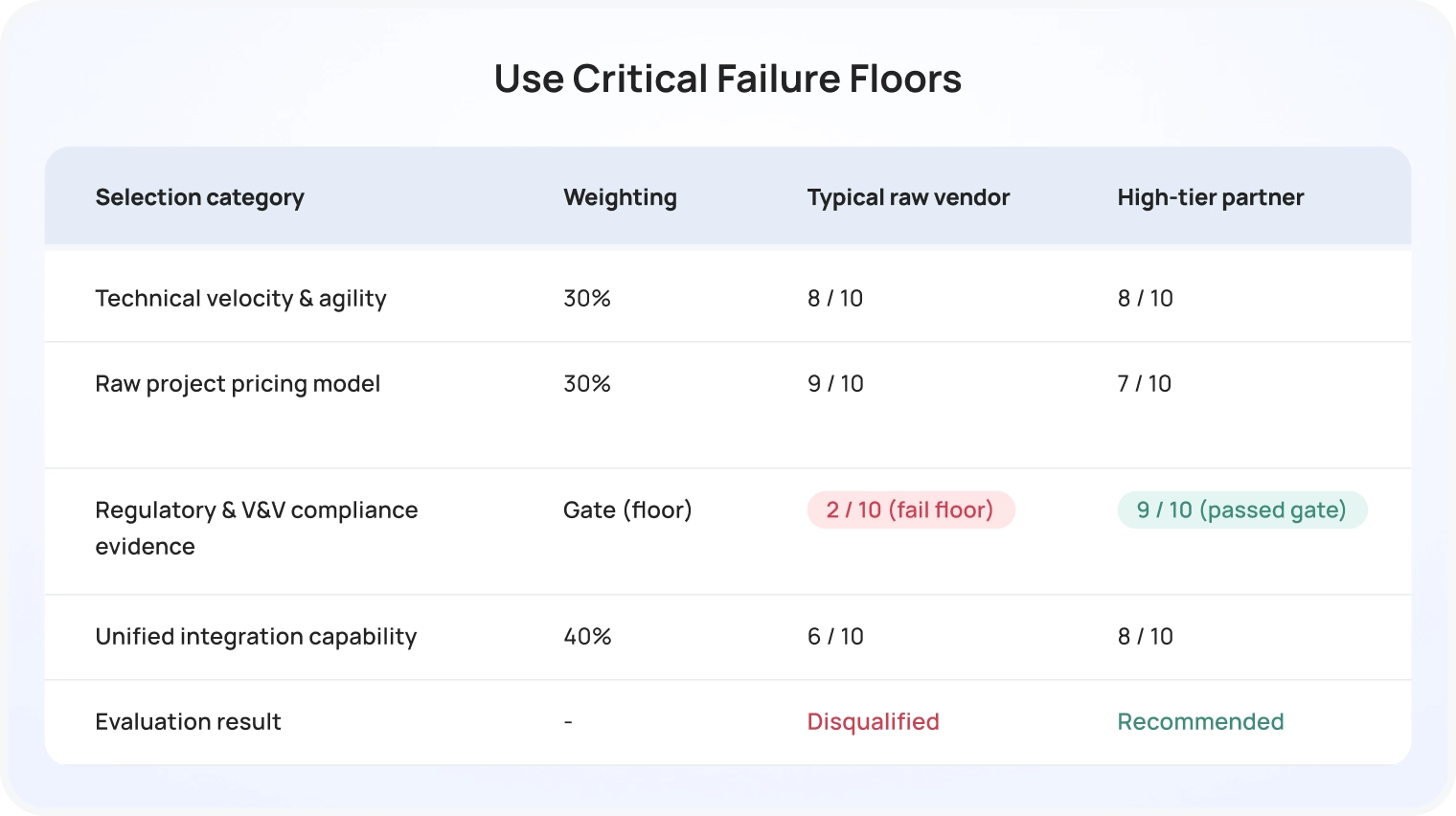
Score on a weighted scorecard with critical-failure floors. Compliance evidence and integration capability cannot be averaged away by a strong showing on velocity or price. A vendor who scores high everywhere and fails on V&V evidence fails the evaluation, full stop. Some criteria are gates, not points.
Use Critical Failure Floors
Take the reference calls with the technical lead who would run your build, not only the sponsor who signs the proposal. Ask for the two or three projects closest to yours in regulatory complexity, and ask the traceability question from earlier. The answers separate the partners from the vendors faster than any RFP.
This is the model Flyant is built around: engineering and QA as one function, compliance designed in from the first sprint rather than retrofitted before an audit, and teams who have shipped in your regulatory class before they meet you.
If you are early in selection, start with a paid discovery and ask each finalist for the audit evidence above. The partner who can produce it now is the one whose work will hold up when the inspection is yours.
Choosing a healthcare software partner?
We've shipped 30+ healthcare products with zero failed audits.
Frequently Asked Questions
Didn’t find the answer you are looking for?
Contact usOleg Sadikov is the Chief Executive Officer and co-founder of Flyant. He started the company with a clear vision: to raise the bar for healthcare software quality and turn QA into a genuine business enabler rather than a formality in the delivery process. Under his leadership, Flyant has built and scaled a global engineering and QA organization focused on real product outcomes, with quality strategy that stays aligned to each client's business goals.
